Resident Crews of the International Space Station (ISS)

ISS: Expedition 74 |
 |
 |
 |
 |
 |
 |
 |
 |
|
Crew, launch- and landing data
| No. | Nation | Surname | Given names | Position | Spacecraft (launch) |
Launch date |
Launch time |
Spacecraft (landing) |
Landing date |
Landing time |
Mission duration |
| 1 |  |
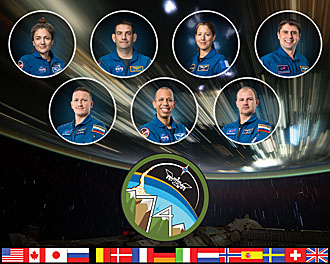
Fincke | Edward Michael "Mike" | ISS-CDR * | SpaceX Crew-11 | 01.08.2025 | 15:43:42 UTC | SpaceX Crew-11 | 15.01.2026 | 08:41:36 UTC | 166d 16h 57m 54s |
| 2 | |
Cardman | Zena Maria | Flight Engineer | SpaceX Crew-11 | 01.08.2025 | 15:43:42 UTC | SpaceX Crew-11 | 15.01.2026 | 08:41:36 UTC | 166d 16h 57m 54s |
| 3 |  |
Yui | Kimiya | Flight Engineer | SpaceX Crew-11 | 01.08.2025 | 15:43:42 UTC | SpaceX Crew-11 | 15.01.2026 | 08:41:36 UTC | 166d 16h 57m 54s |
| 4 |  |
Platonov | Oleg Vladimirovich | Flight Engineer | SpaceX Crew-11 | 01.08.2025 | 15:43:42 UTC | SpaceX Crew-11 | 15.01.2026 | 08:41:36 UTC | 166d 16h 57m 54s |
| 5 | |
Kud-Sverchkov | Sergei Vladimirovich | ISS-CDR * | Soyuz MS-28 | 27.11.2025 | 09:27:57.402 UTC | Soyuz MS-28 | 26.07.2026 | 10:27:25 UTC | 241d 00h 59m 28s |
| 6 | |
Mikayev | Sergei Nikolayevich | Flight Engineer | Soyuz MS-28 | 27.11.2025 | 09:27:57.402 UTC | Soyuz MS-28 | 26.07.2026 | 10:27:25 UTC | 241d 00h 59m 28s |
| 7 | |
Williams | Christopher Leigh | Flight Engineer | Soyuz MS-28 | 27.11.2025 | 09:27:57.402 UTC | Soyuz MS-28 | 26.07.2026 | 10:27:25 UTC | 241d 00h 59m 28s |
| 8 | |
Meir | Jessica Ulrika "Goose" | Flight Engineer | SpaceX Crew-12 | 13.02.2026 | 10:15:55 UTC | SpaceX Crew-12 | (??.09.2026) | UTC | |
| 9 | |
Hathaway | Christopher Stewart "Jack" | Flight Engineer | SpaceX Crew-12 | 13.02.2026 | 10:15:55 UTC | SpaceX Crew-12 | (??.09.2026) | UTC | |
| 10 |  |
Adenot | Sophie Marie Laurence | Flight Engineer | SpaceX Crew-12 | 13.02.2026 | 10:15:55 UTC | SpaceX Crew-12 | (??.09.2026) | UTC | |
| 11 | |
Fedyayev | Andrei Valerievich | Flight Engineer | SpaceX Crew-12 | 13.02.2026 | 10:15:55 UTC | SpaceX Crew-12 | (??.09.2026) | UTC | |
| 12 | |
Dubrov | Pyotr Valerievich | Flight Engineer | Soyuz MS-29 | 14.07.2026 | 14:47:43.552 UTC | Soyuz MS-29 | (??.02.2027) | UTC | |
| 13 | |
Kikina | Anna Yuryevna | Flight Engineer | Soyuz MS-29 | 14.07.2026 | 14:47:43.552 UTC | Soyuz MS-29 | (??.02.2027) | UTC | |
| 14 | |
Menon | Anil Madhavan Samoilenko | Flight Engineer | Soyuz MS-29 | 14.07.2026 | 14:47:43.552 UTC | Soyuz MS-29 | (??.02.2027) | UTC |
On January 12, 2026 Sergei Kud-Sverchkov replaced Mike Fincke as ISS-CDR
 |
Expedition Report
|
Expedition 74 began with undocking of
Soyuz
MS-27 on Dezember 09, 2025 at 01:41:30
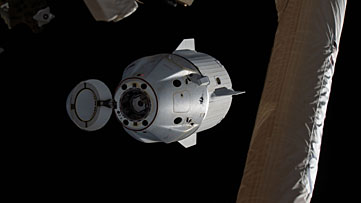
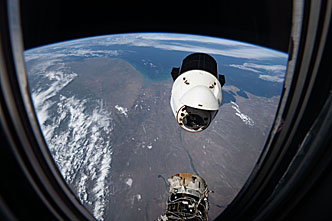
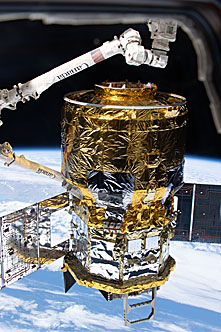
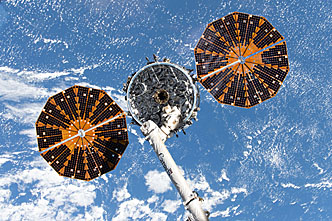
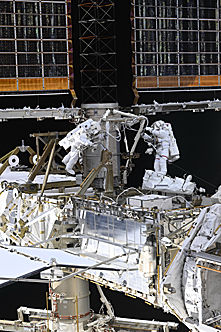
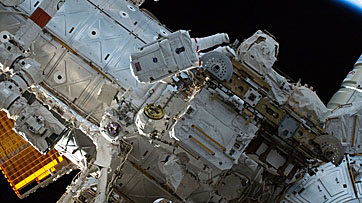
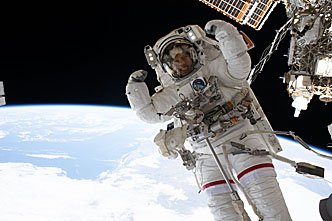
UTC. The initial revelation, which was first described by the agency as a "medical concern," caused NASA to announce on January 07, 2026 evening that it was postponing the first spacewalk of 2026 from the ISS. Michael Fincke and Zena Cardman had been scheduled to venture outside the station on January 08, 2026 morning. A spacewalk on January 08, 2026 was slated to have Michael Fincke and Zena Cardman perform a variety of operations around the orbiting outpost during the roughly 6.5-hour-long event. A new date for the spacewalk hasn't been announced. NASA is weighing whether it may need to call for an earlier end the SpaceX Crew-11 mission on the International Space Station after a "medical situation". After discussions with Chief Health and Medical Officer Dr. J.D. Polk and leadership across the agency, NASA came to the decision that it’s in the best interest of our astronauts to return SpaceX Crew-11 ahead of their planned departure (in late February 2026). On Janaury 12, 2026 the station command changed from US astronaut Michael Fincke to Russian cosmonaut Sergei Kud-Sverchkov. SpaceX Crew-11 with Zena Cardman, Michael Fincke, Kimiya Yui and Oleg Platonov undocked on January 14, 2026 at 22:05 UTC and splashed down on January 15, 2026 off the coast of California. On February 14, 2026 at 20:15 UTC SpaceX Crew-12 docked to the International Space Station. Jessica Meir, Christopher Hathaway, Sophie Adenot and Andrei Fedyayev became members of Expedition 74. The Dragon spacecraft SpX-33 or CRS-33 autonomously undocked from the Harmony module's forward-facing port on February 26, 2026 at 17:05 UTC and fired its thrusters to move safely away from the space station. Splashdown was on February 27, 2026 at 07:44 UTC off the coast of California. Several scientific investigations are returning aboard Dragon, offering insights that could help shape future space exploration and life on Earth. The Euro Material Ageing study exposed 141 samples to space for a year to examine how coatings, insulation, and 3D-printed materials degrade, while Thailand's Liquid Crystals experiment observed the stability of films used in electronics in microgravity. Both could lead to stronger spacecraft, better displays, and improved optical devices on future missions. Frozen samples from the Stellar Stem Cells Mission 2 experiment are helping study how microgravity affects brain and heart stem cell growth, which could improve treatments for diseases such as ALS and Parkinson's disease. The SpaceDuino project is paving the way for more low-cost instruments after successfully measuring vibrations using a commercially available single-board computer and open-source software. The Moon Microscope also successfully tested a portable diagnostic kit for blood analysis in space that could support future missions to the Moon and Mars. The Dragon spacecraft supporting the mission also introduced a new capability to reboost the space station, helping maintain its altitude and counter atmospheric drag, which is critical for safe operations and the long-term sustainability of the orbital complex. During its time docked to the station, Dragon performed six reboosts - five in 2025 and a final maneuver on January 23, 2026 - before preparations for its departure began. After delivering about 12,000 pounds (5440 kilograms) of supplies, scientific investigations, hardware, and other cargo to the International Space Station for NASA and its international partners, JAXA's (Japan Aerospace Exploration Agency's) uncrewed HTV X1 cargo spacecraft departed on March 06, 2026 at 17:00 UTC. On March 05, 2026 at 19:26 UTC flight controllers used the space station's Canadarm2 robotic arm to detach HTV-X1 from the Harmony module's Earth-facing port on the station and maneuver it into position for release. Chris Williams monitored HTV-X1's systems during undocking and departure. The HTV-X1 spacecraft will remain in orbit for more than three months acting as a scientific platform for JAXA's experiments. Following the deorbit command, the spacecraft will dispose of several thousand pounds of trash during re-entry into Earth's atmosphere, where it will burn up harmlessly. After delivering more than 11,000 pounds (4989 kilograms) of supplies, science investigations, hardware, and other cargo to the International Space Station for NASA and its international partners, the Cygnus XL spacecraft ("S.S. William "Willie" C. McCool") supporting Northrop Grumman's 23rd Commercial Resupply Services mission departed the orbiting laboratory on March 12, 2026 at 11.06 UTC. Flight controllers on the ground sent commands for the space station's Canadarm2 robotic arm to detach the Cygnus XL spacecraft from the Unity module's Earth facing port and maneuver it into position for release Sophie Adenot monitored Cygnus' systems as it departs. Cygnus XL will be commanded to deorbit on March 14, 2026 to dispose of several thousand pounds of trash during its reentry into Earth's atmosphere, where it will harmlessly burn up. The Progress MS-31 cargo spaceship undocked from the Russian segment of the International Space Station (ISS) from the Poisk module at about 13:24 UTC on March 16, 2026. The freighter turned on its thrusters for braking at about 16:42 UTC to begin descent from the ISS orbit and enter the Earth's atmosphere. Most of the spacecraft will burn up in the dense layers of the atmosphere, while its non-combustible parts will splash down into the South Pacific Ocean Uninhabited Area and sink. On March 18, 2026 Jessica Meir and Christopher Williams performed the first spacewalk in this Expedition 74 (7h 02m). They exited the station's Quest airlock to prepare the 2A power channel for future installation of International Space Station Roll-Out Solar Arrays. Once installed, the array will provide additional power for the orbital laboratory, including critical support of its safe and controlled deorbit. The unpiloted Roscosmos Progress MS-33 resupply spacecraft launched at 11:59:51.292 UTC on March 22, 2026 on a Soyuz rocket from the Baikonur Cosmodrome in Kazakhstan. After a two-day trip to the space station, the spacecraft docked due to the malfunction of one of the two KURS antennas manually to the Poisk module's space-facing port at about 13:40:44 UTC on March 24, 2026. The Progress MS-33 spacecraft will remain docked to the orbiting laboratory for about six months before departing for a destructive re-entry into Earth's atmosphere to dispose of trash loaded by the crew. A Northrop Grumman Cygnus XL "S.S. Steven R. Nagel" spacecraft launched on April 11, 2026 at 11:41:21 UTC to the orbital laboratory on a SpaceX Falcon 9 rocket for NASA. The mission is known as NASA's Northrop Grumman Commercial Resupply Services 24 (NASA's Northrop Grumman CRS-24) and launched from Space Launch Complex 40 at Cape Canaveral Space Force Station in Florida. Northrop Grumman's Cygnus XL spacecraft is carrying approximately 11,000 pounds (4,900 kilograms) of cargo to the orbiting laboratory. NASA is sending more science, technology demonstrations, and crew supplies to the International Space Station following the successful launch of the agency's Northrop Grumman Commercial Resupply Services 24 mission, or Northrop Grumman CRS-24. The resupply mission is carrying dozens of research experiments that will be conducted during Expedition 74/75, including a new module to advance quantum science that could improve computing technology and aid in the search for dark matter, and hardware to produce a greater number of therapeutic stem cells for blood diseases and cancer. Cygnus also carries model organisms to study the gut microbiome and a receiver that could enhance space weather models to protect critical space infrastructure, such as GPS and radar. These experiments are just some of the hundreds of scientific investigations conducted aboard the orbiting laboratory in the areas of biology and biotechnology, Earth and space science, physical sciences, and technology development and demonstrations.Following launch, astronauts aboard the space station used the Canadarm2 robotic arm to captured Cygnus at 17:20 UTC and installed the spacecraft to the Unity module's Earth-facing port for cargo unloading. The spacecraft will remain at the space station until October 2026. This is the company's 24th spacecraft built to deliver supplies to the International Space Station under contract with NASA. Progress MS-32 undocked from the ISS (Zvezda module) on April 20, 2026 at 22:08:30 UTC. It burned up over the Pacific Ocean on April 21, 2026 around 02:05 UTC. The unpiloted Progress MS-34 resupply spacecraft launched at 22:21:47.460 UTC on April 25, 2026 on a Soyuz rocket from the Baikonur Cosmodrome in Kazakhstan. The cargo includes: Fuel for refueling the station; Food for the crew: fresh apples, oranges, grapefruit, cabbage soup, borscht, rassolnik (pickle soup), goulash, wheat milk porridge, cottage cheese with nuts, peach dessert, yogurts, condensed milk, and cookies; Drinking water; Sanitary and hygienic products; Oxygen for the ISS's internal atmosphere. The freighter carried the new EVA space suit Orlan MKS No. 8. The following experiment equipment and consumables was also sent into orbit: Virtual: (using VR goggles and devices that monitor the body's reactions, they are testing how weightlessness affects vision, the vestibular system, and spatial orientation); Neuroimmunity: (studies the effects of stress on the immune system and nervous system); Correction: (researching the problem of bone mass loss during spaceflight); Biodegradation: (testing how microorganisms affect materials inside the ISS); Separation: (researching and improving water regeneration methods). After a two-day trip to the space station, Progress docked autonomously to the aft port of the Zvezda module at 00:00:46 UTC on April 28, 2026. The Progress MS-34 spacecraft will remain docked to the orbiting laboratory for about seven months before departing for a re-entry into Earth's atmosphere to dispose of trash loaded by the crew. On May 15, 2026 at 22:05:41 UTC the unpiloted SpaceX Dragon SpX-34 or CRS-34 spacecraft launched from Space Launch Complex 40 at Cape Canaveral Space Force Station in Florida. The freighter carries about 6,500 pounds (2,950 kilograms) of cargo. In addition to food, supplies, and equipment for the crew onboard the station, Dragon will deliver several new experiments, including a project to determine how well microgravity simulators mimic microgravity conditions, a bone scaffold made from wood that could produce new treatments for fragile bone conditions like osteoporosis, and equipment to help researchers evaluate how red blood cells and the spleen change in space. The Dragon spacecraft also carries a new instrument to monitor charged particles around the Earth that impact power grids and satellites, and an investigation that could provide a fundamental understanding of how planets form. The Dragon spacecraft is scheduled to remain at the space station until mid-June 2026 when it will depart the orbiting laboratory and return to Earth with time-sensitive research and cargo, ahead of splashing down off the coast of California. The SpaceX spacecraft, loaded with nearly 6,500 pounds of cargo for the space station's Expedition 74 crew, docked autonomously at 10:37 UTC on May 17, 2026, to the forward port of the station's Harmony module. On May 27, 2026 Sergei Kud-Sverchkov and Sergei Mikayev performed a spacewalk (6h 06m). They installed new equipment and brought the results of unique experiments back to Earth. Main tasks were: Installation of the Solntse Terahertz Equipment: On the Zvezda module, the cosmonauts installed a radio telescope weighing approximately 50 kg. It is directed toward the Sun to help scientists investigate the nature of solar flares and improve their prediction. Experiment Ekran-M: The ERA robotic arm transported one of the cosmonauts to the Nauka module. There, he retrieved a cassette containing substrates on which a layer of gallium arsenide semiconductor had been formed in space. The ultra-high vacuum of space enables the growth of ultra-pure materials and holds great promise for the electronics of the future. Return of the Biorisk Experiment: The cosmonauts retrieved the third container of the Biorisk experiment from the Poisk module. It spent nearly five years in space! Scientists will determine how bacteria, seeds, and crustacean cysts survived exposure to the vacuum and radiation. The Dragon SpX-34 or CRS-34 spacecraft undocked from the forward port of the station's Harmony module on June 16, 2026 at 16:25 UTC, after receiving a command from SpaceX ground controllers. The spacecraft then fired its thrusters to move safely away from the orbiting complex. Following the departure, the spacecraft reentered Earth's atmosphere on June 17, 2026 before splashing down off the coast of California at approximately 12:11 UTC. Dragon returned to Earth with thousands of pounds of cargo, carrying samples that could shape future space exploration and life on Earth. Research returning includes bioprinted organ and cartilage tissue, data on improving cryogenic fuel storage for future space missions, and DNA inspired materials to develop new cancer treatments. The returning hardware includes an ocular imaging device used to monitor crew members' eye health, an absorbent bed that filters trace contaminants from cabin air, and a separator pump from the waste and hygiene compartment. On June 30, 2026 Christopher Williams and Jessica Meir performed a spacewalk (7h 20m). They ventured outside the International Space Station to replace a wrist joint on the orbital complex's Canadarm2 robotic arm that malfunctioned during normal Canadarm2 operations on May 27, 2026 after the arm drew elevated motor current and did not move as expected. NASA worked alongside CSA to understand the issue and determined a spacewalk was required to replace the joint using a spare already aboard the space station. Repairs to robotics, like Canadarm2, are normal and expected after more than 25 years of continuous operations, as the system was designed with replaceable components and planned maintenance in mind. On July 25, 2026, the command changed from Russian cosmonaut Sergei Kud-Sverchkov to U.S. astronaut Jessica Meir. Expedition 74 concluded with undocking of Soyuz MS-28 on July 26, 2026 at 07:02:55 UTC and the new Expedition 75 began. |
EVA data
| Name | Start | End | Duration | Mission | Airlock | Suit | |
| EVA | Meir, Jessica | 18.03.2026, 12:52 UTC | 18.03.2026, 18:54 UTC | 7h 02m | ISS-74 | ISS - Quest | EMU No. 3015 |
| EVA | Williams, Christopher | 18.03.2026, 12:52 UTC | 18.03.2026, 18:54 UTC | 7h 02m | ISS-74 | ISS - Quest | EMU No. 3003 |
| EVA | Kud-Sverchkov, Sergei | 27.05.2026, 14:18 UTC | 27.05.2026, 20:24 UTC | 6h 06m | ISS-74 | ISS - Poisk | Orlan-MKS No. 7 |
| EVA | Mikayev, Sergei | 27.05.2026, 14:18 UTC | 27.05.2026, 20:24 UTC | 6h 06m | ISS-74 | ISS - Poisk | Orlan-MKS No. 6 |
| EVA | Williams, Christopher | 30.06.2026, 12:20 UTC | 30.06.2026, 19:40 UTC | 7h 20m | ISS-74 | ISS - Quest | EMU No. 3003 |
| EVA | Meir, Jessica | 30.06.2026, 12:20 UTC | 30.06.2026, 19:40 UTC | 7h 20m | ISS-74 | ISS - Quest | EMU No. 3015 |
Photos
 |
 |
 |
 |
 |
 |
 |
 |
 |
 |
 |
 |
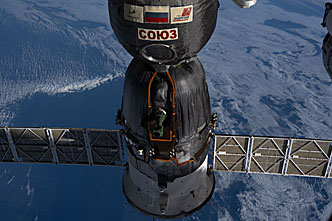 |
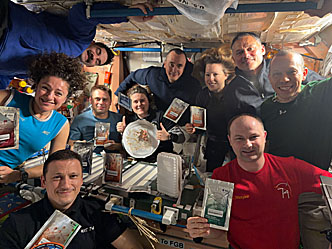 |
more onboard photos |
|
Earth observation photos |
|
more EVA photos |
|
| © |  |
Last update on July 26, 2026.  |
 |